Guides
Boiler efficiency ratings explained
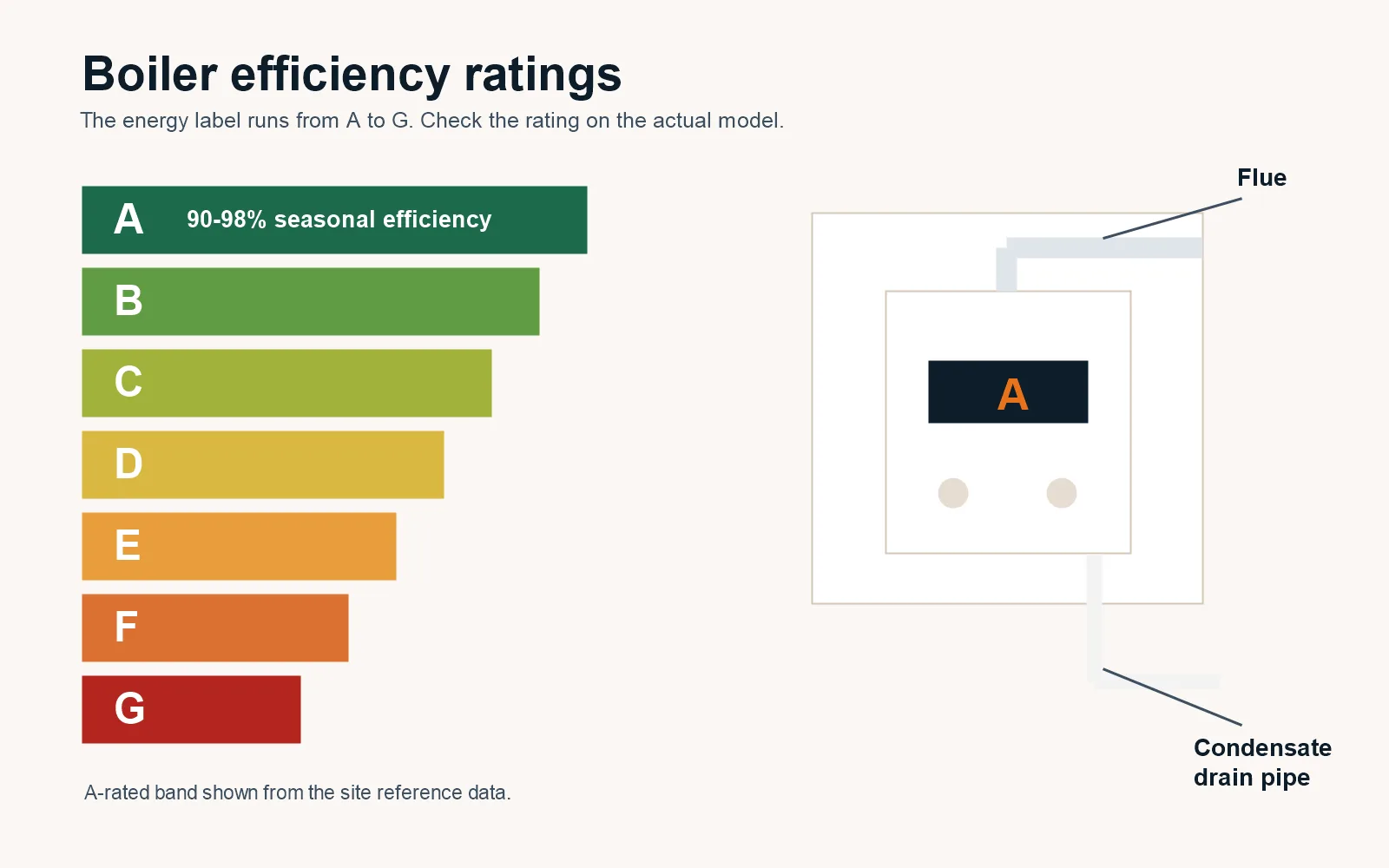
Boiler efficiency ratings tell you how much of the energy a boiler uses ends up as heat in your home. A modern gas boiler is rated on a label that runs from A+++ at the top to G at the bottom, and a gas boiler can reach class A, which covers 90% up to, but not including, 98%. In England, the minimum a new gas boiler has to reach is 92%. A gas boiler that meets that minimum therefore falls inside class A, so the differences that matter when you compare quotes are elsewhere.
What boiler efficiency ratings measure
All modern, well-maintained boilers burn their fuel efficiently, according to the Energy Saving Trust. Some heat is still lost up the flue, which is the pipe that extracts fumes and brings in fresh air. A boiler’s efficiency rating is a measure of how much of that heat it manages to keep.
The figure used on the energy label is a seasonal space heating efficiency, written ηs in the government’s consultation paper.
The A to G energy label
The label for boilers and combination heaters currently has ten classes, from A+++ down to G. Class A covers 90% up to, but not including, 98%, and the government’s own paper says that gas boilers can achieve class A. That is the highest class a gas boiler reaches.
This has a practical effect when you compare quotes. A new gas boiler from a reputable range will usually carry the same A on the label as its rivals, so the label doesn’t tell you which one to buy. For that you need the warranty, the output and the price, which our boiler brands guide compares.
The minimum efficiency for a new gas boiler
The government’s consultation on space heating describes a minimum efficiency of 92% for gas boilers, set under the Boiler Plus Standards in Approved Document L of the English Building Regulations. Scotland, Wales and Northern Ireland have their own building rules, so check the rules for your nation before you rely on this.
The same document is a consultation, not a final rule. It proposes to change the scale, so that the label would run from A to G only, and to tighten other requirements for gas combi boilers. The consultation has closed, and what the government finally decides may change what labels show. Read the paper itself, linked below, for the detail.
How to tell a condensing boiler
Modern condensing boilers are more efficient than older ones because they capture and reuse more of the heat in the gases that would otherwise escape through the flue. The Energy Saving Trust gives three ways to tell whether yours is one:
- The flue. A plastic flue points to a condensing boiler. A metal one makes it unlikely.
- The drain pipe. A condensing boiler has a plastic pipe coming out of the bottom and through the wall into a drain.
- The age. A gas or LPG boiler installed after 2005 is a condensing boiler, as is an oil boiler installed after 2007.
If yours isn’t, a replacement will almost certainly be more efficient. The Energy Saving Trust puts the typical cost of replacing a G-rated gas boiler with an A-rated one, with thermostatic radiator valves, at £3,500. That is an average, and our combi boiler prices page shows what each type and model costs fitted.
What efficiency means for your bills
Heating and hot water make up over half of what a household spends on energy in a year, according to the Energy Saving Trust, so an efficient boiler makes a real difference. A better boiler is only part of it. Good controls, a clean system and a boiler sized to the home all affect what you pay, and an installer should look at them together.
Efficiency isn’t the only reason to change. A boiler that keeps faulting, whose parts are hard to find or that no longer heats the house is a reason too. Our guide to boiler fault codes explains how to read a fault, and our boiler types page shows the options when you replace.
Using boiler efficiency ratings when you choose
Check the label for the class, and then ask each installer for the make, range, output and warranty. A like-for-like combi boiler swap is the cheapest replacement, and you can compare quotes to see each one against the others. If you are on a low income, see our guide to boiler grants for what help exists. When you are ready, get free quotes from Gas Safe installers.
Sources: Energy Saving Trust, Boiler types explained and GOV.UK, Raising product standards for space heating, read on 3 November. The GOV.UK paper is a closed consultation, so check for the final rules.
Get quotes for your home
A guide price only takes you so far. Local firms can price the work on your own home, and comparing a few quotes is the quickest way to see what is reasonable.
Compare free quotes